Lake Nasser Cruise: A Journey Into Ancient Nubia’s Forgotten Heart
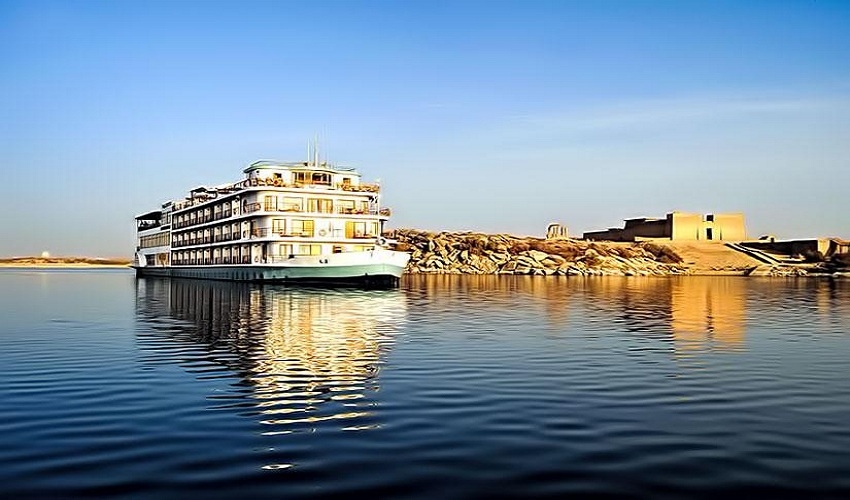
The first thing you notice is the silence. Not the absence of sound, but the presence of something deeper, something older than words. The water laps gently against the hull, a bird calls from a distant shore, and the desert wind whispers through the palm fronds on deck Lake Nasser Cruise . This is Lake Nasser, the great reservoir created by the Aswan High Dam, and it is one of the most peaceful places on earth. A Lake Nasser cruise is not simply a trip; it is an invitation to slow down, to breathe, and to witness a side of Egypt that most travelers never see. The crowded bazaars of Cairo, the bustling corniche of Luxor, the endless queues at the Valley of the Kings—all of that feels like a distant memory. Here, on this vast blue sea surrounded by golden desert, you are alone with history.
The lake itself is enormous, stretching over five hundred kilometers from Aswan in Egypt to the Dal Cataract in Sudan. It was formed when the Nile was dammed in the 1960s, and it swallowed entire villages, ancient temples, and stretches of Nubian homeland. But out of that loss came one of the greatest archaeological rescue efforts in history. UNESCO and the Egyptian government dismantled and moved dozens of monuments to higher ground, saving them from the rising waters. Today, a Lake Nasser cruise takes you to these rescued treasures, sites that are otherwise almost impossible to reach. There are no roads here, no airports, no crowds. Only the boat, the water, and the temples.
The vessels that sail Lake Nasser are small and intimate, carrying perhaps twenty to fifty passengers. They are not floating resorts; they are comfortable, elegant, and designed for quiet observation. Your cabin has a window that looks out onto the desert, and the upper deck is the perfect place to watch the world drift by. Meals are served at set times, and the food is fresh and simple: fish from the lake, warm bread, salads, rice, and fruit. In the evenings, the Nubian crew often shares their music, filling the night air with songs that speak of love, loss, and the river that once ran free. There is no internet, no television, no distraction. You read, you write, you talk with your fellow travelers, or you simply sit in silence and let the peace wash over you.
The first major stop on most itineraries is Kalabsha, a temple dedicated to a Nubian god and later adorned by Roman emperors. It was moved to the island of New Kalabsha to save it from the flood, and today it stands as a lonely, beautiful testament to the rescue efforts. Nearby is Beit el-Wali, a small temple carved into rock by Ramesses II, its walls covered in colorful reliefs of the pharaoh in battle and worship. These sites are rarely crowded, and you may find yourself alone among the ancient stones, the silence broken only by the call of a distant bird. It is a feeling of discovery that is almost impossible to find elsewhere in Egypt.
But the heart of every Lake Nasser cruise is Abu Simbel. The great temple of Ramesses II, with its four colossal statues seated against the cliff, is one of the most iconic sights in the world. Arriving by water transforms the experience. You approach slowly, watching the temple grow larger on the horizon, and you disembark onto a quiet dock far from the noisy crowds that fly in from Aswan. You walk the path to the façade in the soft light of early morning or late afternoon, and you have time to linger, to study the carvings, to feel the weight of three thousand years of history. Inside, the famous solar alignment, which illuminates the inner sanctum twice a year, feels like a secret the ancients left for you alone. The smaller temple of Nefertari, dedicated to Hathor and to Ramesses’s beloved queen, is equally moving, its façade adorned with statues of the royal couple standing as equals.
Beyond the monuments, Lake Nasser offers a kind of peace that is increasingly rare in the modern world. You will spend hours watching the shoreline slide past, noticing how the sand changes from gold to russet to pale rose as the sun moves across the sky. You will see birds you cannot name, and perhaps a crocodile sunning itself on a distant bank. You will talk with your fellow passengers, a small international community bound by a shared sense of wonder. Or you will simply sit in silence, letting the heat and the water and the timelessness of the place wash over you. In a world that never stops moving, Lake Nasser offers something precious: the chance to be still.
As the cruise draws to a close and the boat turns back toward Aswan, you may find it difficult to imagine returning to ordinary life. The lake has a way of getting under your skin, of recalibrating your sense of time and scale. You have seen temples that were saved from drowning, and you have seen a way of travel that feels almost sacred. A Lake Nasser cruise is not a vacation in the usual sense. It is a pilgrimage, a meditation, a journey into the heart of a drowned world that refuses to be forgotten. The pharaohs built their monuments for eternity, and on these quiet waters, eternity feels very close indeed. You will carry the lake with you long after you leave it, a blue memory in the corner of your mind, calling you back again and again.